
Just Starting Out? Consider Fiscal Sponsorship

By | Nonprofit | No Comments

Nonprofit organizations just starting out may not have their 501(c)(3) designation yet. This makes it almost impossible to receive charitable donations and apply for grants. One solution they can explore is fiscal sponsorship.

What Is Fiscal Sponsorship?

Fiscal sponsorship for nonprofits is when an established nonprofit acts as an outsourced extension of a new and emerging organization. The legal contract between the two entities establishes their relationship, with the established nonprofit serving as the sponsor. The contract between the two parties does not imply an ownership relationship or a partnership between the entities. Rather, it establishes the guidelines for a working relationship.

By serving as a fiscal sponsor, the established nonprofit provides a valuable service to a newcomer to the nonprofit world. They will charge a fee to cover their services.

What Are the Duties of a Fiscal Sponsor?

The exact duties of a fiscal sponsor are stated in the sponsoring agreement. Some of the more common duties held by sponsors include:

Can Sponsorship Agreements Extend Beyond Financial Assistance?

Yes. Some nonprofits work with a sponsor which extends operational support to the fledgling organization. They may provide back-office support such as bookkeeping services in addition to fundraising and donation management.

The Benefits of Fiscal Sponsorship

Startups face numerous challenges: funding, growth, marketing, accounting, legal needs, and more. Nonprofits face these challenges along with the need to become self-funding over time. Many people who dream of starting a nonprofit choose to work with a sponsor to allow time to test their concept and ensure there’s a place for them in their chosen field.

Another benefit to nonprofits using a sponsor is that they can focus on growing the organization. The time needed to manage accounting, tax preparation, and other back-office tasks can be used for organizational growth and development, as well as program services.

Lastly, larger nonprofits capable of sponsoring a startup often have considerable staff and expertise: legal counsel, an accounting department, and an HR manager. Working with such a team provides startups with access to highly experienced staff at a critical time during the startup phase, which can help them build stronger, better organizations.

Where to Find Fiscal Sponsors

The best place to start looking is among local nonprofits. Use your network of contacts to find out if any local nonprofits offer this service.

Other places to find potential sponsors include:

No matter how you find a fiscal sponsor, as with all work agreements, investigate the sponsor thoroughly. When working with a fiscal sponsor, you must ensure that there’s both a meeting of the minds and the philosophies to make the situation work to your mutual benefit.

Welter Consulting

Welter Consulting bridges people and technology together for effective solutions for nonprofit organizations. We offer software and services that can help you with your accounting needs. Please contact Welter Consulting at 206-605-3113 for more information.

Solving Three Common Grant Management Challenges

By | Grant Management, Nonprofit | No Comments

There are over 900 federal grant programs offered by 26 different grant-making agencies and over 86,000 foundations offering more than $62.8 billion in funding. If your organization taps into any of these funding sources, it is vital to make proper grant management a priority.

Grant recipients must take specific steps to ensure that funds are managed properly. These steps follow both nonprofit accounting best practices and guidelines issued by the U.S. Government Accountability Office and by state agencies, such as the Washington state office of grant management. Nonprofits often miss several steps in the management process. The following are three common grant management challenges, suggested ways to address them, and a proposed solution to streamline grant management throughout your organization.

Grant Management Challenge #1: Lack of Internal Controls

Have you documented your current grant management processes? Internal controls map out the process by which grant funds are received, allocated, and documented. Without written processes for the management of grants, the process may shift into areas that put it out of compliance with applicable laws.

To ensure your organization is following a compliant grant management process, document the steps your group takes to manage the entire process. Process mapping may be useful to view the workflow from start to finish and identify any potential gaps.

Lastly, make sure that all processes are written. If changes are made over time, they should be documented. All internal control documents should be kept in one central location for easy access by the entire team.

Grant Management Challenge #2: Compliance Issues

Documentation requirements also extend to program performance too. Measure and document progress, performance, and plans that utilize grant funds. Failure to do so could put your organization in jeopardy of losing grants. You must monitor and record all relevant activities to provide compliance documentation to the granting organization.

One important step to meet this challenge is to centralize both the grant management function and the records. Many organizations are adding a grant manager position to their staff to ensure full compliance with all regulations. Such a position ensures that one person has their eye on the many areas of compliance record-keeping and reporting needed to satisfy granting organizations.

Grant Management Challenge #3: No Central Grant Management Resources

As mentioned above, some nonprofits are adding a position to their accounting departments whose sole duty it is to manage grants. While this may not be possible in all nonprofits, most can at least add resources to centralize grant management.

Some centralized resources that improve grant management include:

  • Cloud-based file sharing platforms to enable collaboration on documents
  • Grant management software that automates much of the record-keeping
  • A single person responsible for the grant management process, or, if that is not feasible, someone in the accounting or development office who has this on their list of accountabilities

Solve Your Grant Management Challenges

One tool that can help solve all three grant management challenges is grant management software. Software such as Amplifund, available through Welter Consulting, manages many aspects of the grant process including recording, management, and reporting.

If you’re pursuing more grants this year or struggling to manage your existing grant resources, now is a good time to consider software to help you centralize data and streamline resources.

About Welter Consulting

Welter Consulting bridges people and technology together for effective solutions for nonprofit organizations. We offer software and services that can help you with your accounting needs. Please contact Welter Consulting at 206-605-3113 for more information.

How to Use Empathy Mapping to Better Understand Constituents

By | Nonprofit | No Comments
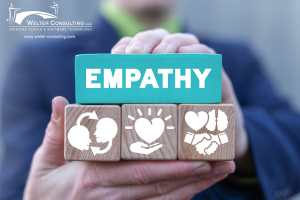
the word empathy and various other blocks being held by a person's hands

Empathy mapping is a new term—and a new approach—to understanding people’s experiences. The purpose is to understand the perceptions and experiences of a particular group so well that you can think, feel, and completely empathize with them, knowing them so well that it is like knowing yourself. By undergoing an empathy mapping exercise, you’ll be able to immerse yourself in the thoughts, feelings, and experiences of a discrete group and thus empathize with them better.

Market researchers have used empathy mapping to understand target audiences for the sole purpose of improving their marketing messages. Now, the concept of empathy mapping is spreading to leadership development as well as other endeavors to build trust, understanding, and alignment among different communities.

If the concept intrigues you, here’s how you can make a start at empathy mapping and, by doing so, better understand what your constituents may need. The results can be applied to improving programs, services, and other deliverables to those served by your nonprofit.

What Is Empathy Mapping?

Empathy mapping is a tool that asks pertinent questions about a discrete group of people. By answering these questions, one gains insight into the group’s thoughts, feelings, motivations, desires, and needs. This, in turn, can fuel improved programs and services for a nonprofit, as well as help improve marketing communications and messaging to the target group. When you truly understand what people feel or desire and what motivates them, you can tap into it with powerful messages.

The Empathy Mapping Process

To engage in the empathy mapping process, first identify the target group. It must be clearly defined. Do not put two or more groups of people together even if you believe they are similar; look at each group separately. For example, an education nonprofit dedicated to helping students get to college may wish to map each school grade as a separate cohort. Starting with high school seniors, they can empathy map seniors (1), juniors (2), sophomores (3), freshmen (4), and so on, down to whatever grade level they deem appropriate, to better understand the motivations, thoughts, needs and desires of each group.

Empathy mapping focuses on four key questions:

  1. Perception: How does this group perceive the world around them?
  2. Action: How do they interact with the world around them?
  3. Feeling: How do they feel? What emotions are they experiencing?
  4. Needs: What are their wants, needs, and goals?

Answers to these questions are then written down in a so-called map, which then forms a picture of the group as a whole. If the answers aren’t known or easily extrapolated, they can be asked of the group.

Group Exercise

Empathy mapping can often be more effective when done as a group exercise. The combined knowledge, experience, and insights from a group offers more depth to the final empathy map.

To perform the exercise in a group, gather together in a conference room and divide a whiteboard into four sections with the headings Perception, Action, Feeling, and Needs. Pass around pens and sticky notes. Ask people to participate by asking the question then having them answer on the sticky note. They can then affix the note to each column. At the end of the exercise, work as a group to write up the statements summarizing the feedback. The emerging picture may surprise you with its clarity and fully fleshed out picture of the target group.

Empathy Mapping Application Methods

Once you’ve created an empathy map, the next step is to use it to refine and enhance your program areas and marketing messages.

  • Use the information about wants, needs, and feelings to fine-tune your programs and services to the target markets’ needs
  • Refine messaging and communication to address fears
  • Restate perceptions and offer alternatives

Everyone wants to feel heard and respected. By using empathy mapping, you’re moving in the right direction to help constituents feel you understand them in a meaningful way.

Welter Consulting

Welter Consulting bridges people and technology together for effective solutions for nonprofit organizations. We offer software and services that can help you with your accounting needs. Please contact Welter Consulting at 206-605-3113 for more information.
Top 3 Challenges Faced by Nonprofit CFOs

By | Accounting, Accounting Software, Nonprofit | No Comments
woman standing at desk looking down at laptop computer

Nonprofit CFOs face many challenges, but the following three may not be ones that immediately come to mind. We often assume that our own challenges are unique—that no one else suffers from spreadsheet overuse, for example—or other organizations are more efficient than we are. But we can tell you from experience that nonprofit CFOs all face similar challenges. And the solutions to these challenges are similar, too.

Challenge 1: Over Reliance on Spreadsheets

Spreadsheets are everywhere. They are easy to use and come with most office productivity suites. Most accounting and financial professionals know how to use them and are very comfortable with them. They enable nonprofits to get their accounting up and running quickly. We’re not knocking spreadsheets, but if your organization is past the startup phase, it’s time to think beyond spreadsheets and look for a more robust accounting solution.

They are myriad problems with using spreadsheets for complex accounting functions. Problems include:

  • Unless cloud hosted, spreadsheets are single user, meaning that only one person at a time can work with a spreadsheet. They must be emailed after updates.
  • Working with complex financial analysis across multiple spreadsheets can be extremely time-consuming and difficult.
  • Formulas are notoriously finicky—one mistaken input and suddenly the whole sheet is off. Worse, mistakes multiply if copied and pasted, making it very hard to find and fix them.
  • They aren’t secure. You can password protect a spreadsheet in some programs, but they can be shared and accessed easily. A compromised password can make them accessible. A computer virus can make them completely inaccessible. They are very risky.

Solution: Transition Your Team to an Accounting Program

It is vital to transition your team away from spreadsheets as soon as possible. Cloud accounting software made specifically for nonprofit organizations provides the structure and resources needed to handle the complex needs of nonprofit finances.

Sage Intacct is an excellent cloud-based accounting program for nonprofits. It offers a cloud-based solution that requires no special hardware to run. The chart of accounts can handle the often-complex reporting needs of nonprofits, and it includes multiple nonprofit-specific accounting functions, such as grant management, FASB accounting accommodations, and more.

Challenge 2: Reports Take Too Long to Produce

Another challenge many nonprofit CFOs face is producing accurate and timely reports. This challenge often goes together with reliance on spreadsheets which produce only limited reports.

Accurate and timely financial reports enable nonprofit managers to make smart decisions about using organizational resources. Without insight into the finances, managers lack an important piece of information.

The solution is to find a good nonprofit accounting program that enables on demand reports. Flexible, customized reporting would be ideal, since managers can then run the reports they need. Automating your accounting will shift the burden of producing reports from the CFO and enable more self-service reporting.

Challenge 3: Billing mistakes.

Nonprofits using spreadsheets often fail to account for their employees’ time properly. They may under- or over-count billable hours, miss expense reports, and generally struggle to adequately track billable time and projects. This can result in a significant shortfall over time and a huge, missed opportunity.

Using Sage Intacct and/or a time tracking software can help you more accurately track such expenses. And, by aligning staff time with specific programs, you can judge how effective specific programs are and whether such time is being used wisely.

Financial Software for Nonprofits

Although spreadsheets can adequately handle basic accounting, they quickly become inefficient as a nonprofit grows. The recent trend towards cloud accounting software has added additional value to software licenses, making them more affordable than ever. If the challenges outlined in this article resonate with you, we invite you to explore Sage Intacct or other cloud accounting solutions through Welter Consulting.

Welter Consulting

Welter Consulting bridges people and technology together for effective solutions for nonprofit organizations. We offer software and services that can help you with your accounting needs. Please contact Welter Consulting at 206-605-3113 for more information.